
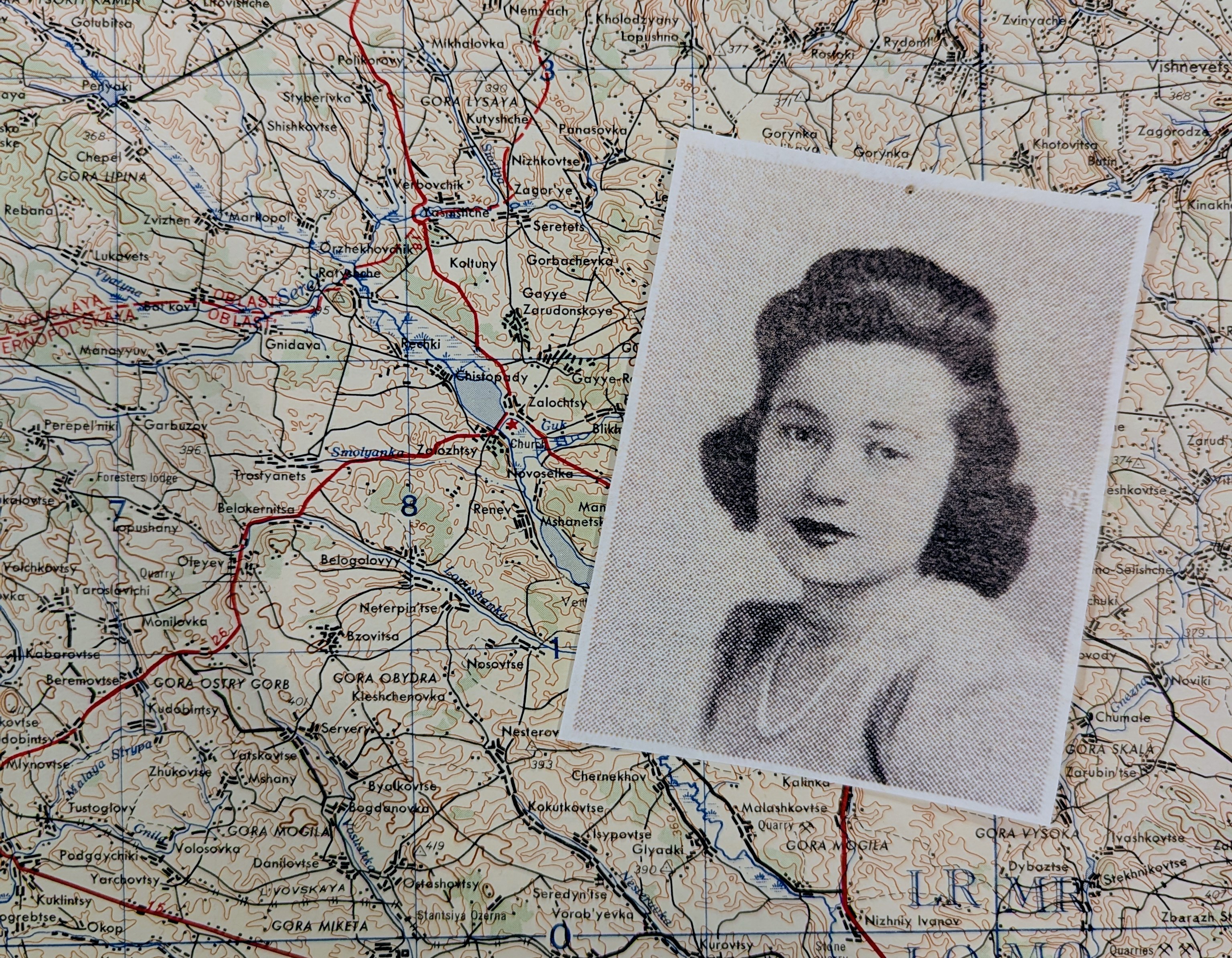
The Army Map Service (AMS) published detailed maps of places all over the world. The Special Collections and Archives subdivision has approximately 20,000 of these maps depicting places within North America, South America, Asia, Africa, Australia, and Europe in different scales. Many of the AMS maps in our collection were published in the 1940s, and although our holdings vary based on location, there is coverage extending into the late 1960s.
For genealogists, the AMS maps have some great uses. They provide a detailed snapshot of the land, towns, transportation, and environments that the people you’re researching lived in and interacted with. Within this set, there are some maps that focus on specific aspects of the area such as government railroads, dedicated roads, and detailed city plans (such as the segment of Marseille, France shown in figure 11).
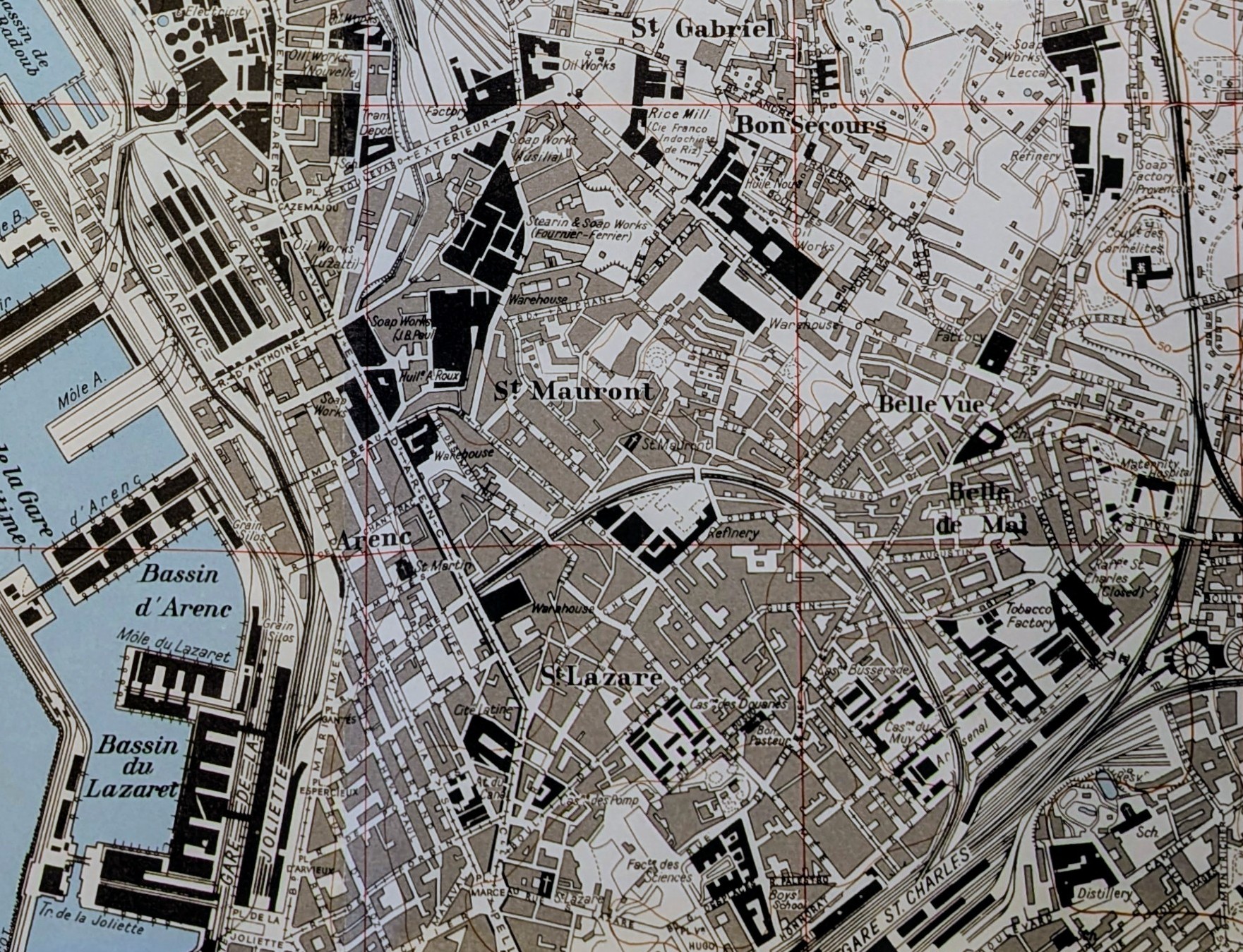
Figure 1. Photograph of an AMS map depicting warehouses, refineries, a tobacco factory, a maternity hospital, soap works, boys school, distillery, and more in Marseille, France.
Maps showing city plans depict the rough footprint of notable buildings such as warehouses, mills, and factories. They also show residential areas and significant institutions like hospitals, cemeteries, and orphanages.
Depending on the scale and the location of the map, researchers might see symbols that indicate telegraph lines, dangerous areas, footpaths, and landing areas. For example, the maps depicting Korea illustrate a wide variety of symbols; researchers can use these maps to locate prisons, churches, pagodas, Navy lookout towers, mines, ancestral shrines, slaughter houses, windmills, roads that are impassable with carts, and more.
An AMS map can help a researcher visualize how people moved and migrated, and they are especially helpful in understanding towns and places that might have been renamed, affected by changed borders, or no longer exist today.
We’ll take a look at how our AMS maps can help us understand the life of Ryfka “Ruby” Auerbach Berkowitz, her family, and communities.
Who was Ryfka Auerbach of Załoźce?
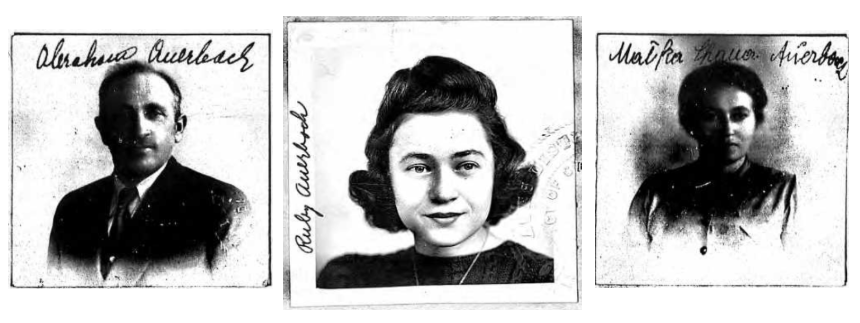
Figure 2. Photos of Abraham, Ruby, and Małka Chana Auerbach from their naturalization documents.
Ruby immigrated to the United States under the name Ryfka Auerbach when she was about 16 years old. Crossing the Atlantic aboard the M.S. Piłsudski, Ruby arrived in New York on 8 October 1938 with her parents, Abraham and Małka Chana (also known as Mollie), and her five year old brother, Rafael. They were leaving their hometown of Załoźce, Poland; and the Auerbach family said goodbye to their mother and grandmother, Maryem (likely Miriam) Auerbach who stayed back home in Załoźce at the time of the Auerbachs' departure. The Auerbachs’ final destination was to join Ruby’s maternal uncle, Chymon [Hyman] Hirshorn, who was living at the Brown Palace Hotel in Denver, Colorado.2.
Interestingly, Denver’s Hirshorn Park was named for Uncle Hyman; after his death in 1946, Hirshorn’s estate provided land for the park, money to build the playground, and funding for events that gave Denver kids free ice cream.3
Eight months after arriving in the United States, Ruby’s parents, Abraham and Mollie, filed their Declarations of Intention on 9 May 1939 in Denver.4 Filing a Declaration of Intention started the Auerbachs on their path to becoming American citizens. Ruby filed her Declaration of Intention to become an American citizen at the District Court in Denver on 2 July 1941, just one week shy of her 19th birthday.5
In the early 1940s, Ruby and her family lived in West Colfax, very close to Denver’s Sun Valley neighborhood; these two areas were early homes to Denver’s vibrant Jewish communities.6 Ruby attended West High School; she was a senior in 1941 and participated in the Nature Club, Girl Reserves, Pre-Medics, Literary Youth, International Relations, S.O.S., and Spur. Her senior photo is identical to the photo she used for her Declaration of Intention.7 After West High School, she started her freshman year at the University of Denver in 1942.8
Ruby married Edwin Berkowitz on 6 June 1943 at her home in Denver. The Intermountain Jewish News described the new bride as, “charming in a white taffeta gown made with a fitted bodice and full dirndl skirt. Her fingertip veil was trimmed with traditional orange blossoms.”9
Ruby and Edwin spent a few years in Chicago, Illinois, possibly because of Edwin’s service in the U.S. Navy; the couple moved there around 20 July 1943 and returned to Denver by 1947.10 Ruby’s naturalization application was completed in Chicago when she filed her Petition for Naturalization and signed the Oath of Allegiance on 25 May 1944 under the name Ryfka Berkowitz.11
Ruby’s history is entwined with the history of the Denver Public Library. In her youth, Ruby would visit the reading room of the Carnegie Library at West Colfax and Bannock, noting that she hadn’t visited a library until she came to America.12 The Carnegie Library building is now the McNichols Civic Center Building and is near the Central Library. As early as 1941 Ruby was employed as a shelver, sometimes known as a page, at the now closed Dickinson Branch Library.13 Her work would include finding and shelving books and other materials. She once reminisced that when she was first hired as a shelver at the Dickinson Branch Library, she didn’t know how to speak English but the hiring librarian gave her an opportunity anyways.14 Ruby was certainly an asset to the library, as the Dickinson Branch Library had significant collections in Hebrew and Yiddish.15 Throughout her time at DPL, Ruby took on different roles and projects. In 1975, Ruby and her colleagues hosted a Hanukkah celebration at DPL’s Hampden Branch.16 In 1988 she worked as a Clerk Typist and by 1990 her job title changed to Keyboard Operator.17 She likely retired from the library in early 1991; in the 7 March 1991 issue of Dewey's Dispatch, the library’s all-staff newsletter at the time, Ruby wrote:
“I would like to take this opportunity to thank all my friends at DPL for cards, good wishes, and also for coming to my retirement party at Hampden Library. The occasion was a sad one for me, but also a happy one because I got to see friends that mean a great deal to me. My years at DPL were very happy and I will always treasure them.”18
Ruby passed away on 28 January 1997. Her obituary notes that she worked at the Denver Public Library for over 30 years. Ruby is buried at Rose Hill Cemetery in Denver.19
Poland and Her Changing Borders: Spotlight on Załoźce
The Second Polish Republic existed between 1918 and 1939, from when Poland regained her independence after World War I and when Poland was invaded at the beginning of World War II. When Ruby and her brother Ralph were born in Załoźce, Poland, this was the era of Poland that they were born into.
Previous to the Second Polish Republic, Poland was partitioned by Austria, Prussia, and Russia. Like Ruby and Ralph, their father, Abraham, was born in Załoźce, however in 1899 when Abraham was born, Załoźce was within the Austrian partition of Poland.20 Researchers can see this exemplified in the 1940 U.S. Federal Census in Figure 3; Abraham and his wife Mollie are indicated to have been born in Austria while Ruby and Ralph are listed as being born in Poland. The census shows that all four Auerbachs lived in Poland in 1935. Abraham was the person who spoke to the census enumerator, as indicated by the circled x near his name.21 Researchers can use the knowledge of the informant’s identity to weigh the information’s credibility.

Figure 3. A segment of the 1940 U.S. Federal Census showing Abe, Mollie, Ruby, and Ralph Auerbach. Abe and Mollie’s places of birth are recorded as Austria and Ruby and Ralph were recorded as being born in Poland. The furthest right column of this segment shows that the family was residing in Poland on 1 April 1935.
Germany and the Soviet Union signed the Molotov-Ribbentrop Pact on 23 August 1939, less than one year after the Auerbachs’ arrival into the United States. The two countries agreed that Poland would be divided, with the Soviet Union taking Eastern Poland and other Eastern European countries and Germany seizing Western Poland. Hitler began his invasion of Poland on 1 September 1939 and the Soviet Union invaded on 17 September 1939. By 6 October, two days shy of a year from when the Auerbach family arrived in New York, Poland was under German and Soviet occupation.22 The town of Załoźce, and the family and communities that the Auerbachs left behind, were now within Soviet control.
The chapter on Załoźce from the translated and transcribed Encyclopedia of Jewish Communities in Poland provides few details about what life was like for the residents of Załoźce during this time, noting that some Jewish families were deported east into the Soviet Union, and that synagogues remained in service while other community establishments closed.23
The Soviet occupation of Załoźce lasted nearly two years before Germany broke its pact with the Soviet Union and invaded the lands that the Soviets had claimed. Załoźce was under German occupation on 9 July 1941, and the Nazis began to murder the Jewish residents. Others were kidnapped and forcibly brought to work camps. In October 1942, the Nazis considered Załoźce as Judenrein, meaning that there was no longer a Jewish presence in the town, as the Nazis brought the remaining Jewish residents to Zborów.24 Approximately 3,000 Jewish people were kept in the Zborów ghetto, which was “located on two streets near the river and was surrounded with barbed wire.”25
According to Yad Vashem: the World Holocaust Remembrance Center, 2,300 people in the Zborów ghetto were murdered after being forced to dig their own graves. By June 1943, the remaining people in the Zborów ghetto were executed.26 The buildings of the ghetto were set on fire to force out any Jewish people who survived the executions.27
After the war, the Hirshorn-Auerbach families in America believed that Ruby’s maternal aunt, Clara Eisenbruch and her children, and Ruby’s maternal uncle, Tewel Hirschhorn, were murdered by the Nazis. The Eisenbruch family were killed in the Zborów ghetto during the spring of 1943, while it was understood that Tewel Hirschhorn escaped the ghetto but was later found hiding in the forest and murdered by Nazis in 1944.28 Additional research into Clara Eisenbruch, her children, and Tewel Hirshhorn is needed.
When World War II ended, Poland’s borders continued to change. Załoźce, now known as Zaliztsi, is in Ukraine.
Using the Army Map Service Maps to Illustrate a Family Story
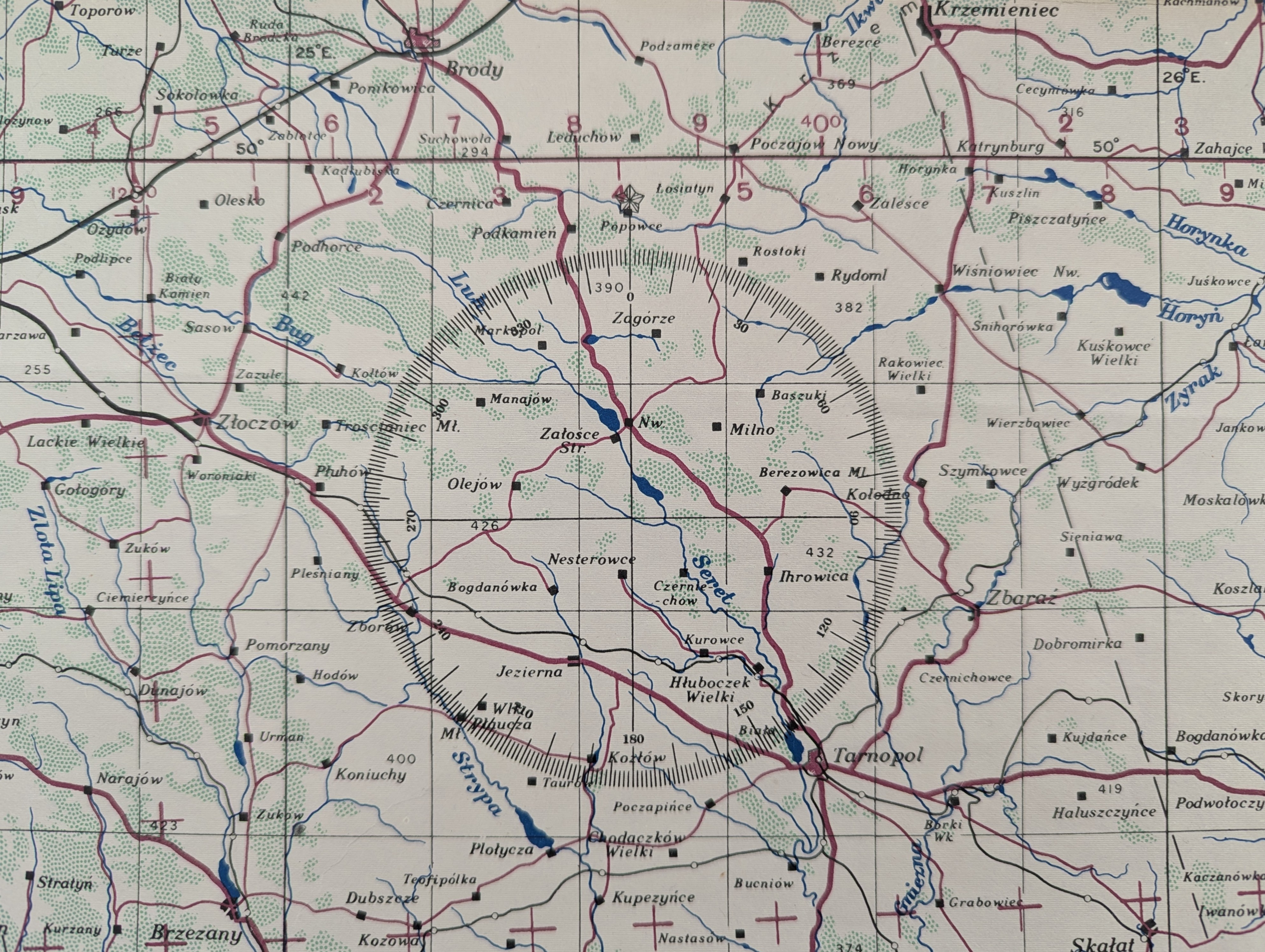
Figure 4. A snapshot of the AMS map showing Załoźce along the Seret River.29
Maps can help us imagine Ruby Auerbach Berkowitz’ early life. When she boarded the M.S. Piłsudski with her family on 28 September 1938, it was in the city of Gdynia, Poland.30 The earliest AMS map DPL has showing Załoźce is from 1944; the landscape and infrastructure might have changed between when Ruby and her family were in Europe and the map was created, so researchers should evaluate each map for the likelihood of changes and how practical its application to the research question is. Despite this map being created several years after Ruby and her family left Poland, this AMS map can still help us get an idea of the likely roads and railways that the Auerbach family might have taken to travel northwest to get to Gdynia and the ship that would take them to America.
We find Załoźce situated along the Seret River. Stare Załoźce, or Old Załoźce is to the south of a lake not named on the map, and Nowe Załoźce, meaning New Załoźce, is to the southeast of the lake at the cross of a minor and major road. In 1944, the town was most accessible by roadways or by foot, and researchers can trace a path that likely would have taken the Auerbach family through major cities, like Lublin and Warsaw. Researchers know that Ruby traveled through Warsaw, as her passenger arrival list indicates that Ruby received quota immigration visa number 762 in Warsaw on 10 August 1938, seven weeks before she departed Europe.31
We can follow the map to see which roadway connected with a rail station that might have supported passenger trains. A map can tell us if Ruby likely traveled through stretches of forest and had to have crossed the Vistula River, Poland’s longest river. We can use a map to estimate how many kilometers the trip from Załoźce to Warsaw to Gdynia was based on the infrastructure that was available at the time, and then we can estimate how long the voyage might have taken the family. That information would allow researchers to determine a possible timeframe for when Ruby and her family left Załoźce.
We can use the same map to understand more about the Jewish people who resided in Załoźce until they were forced to the Zborów ghetto. In 1944, a minor roadway connected the two towns at a distance of about 25 kilometers. If they followed the road, they would have passed scattered woods, a small town called Olejów, a river, and a train station on a single track or light railway. Researchers can see that a major roadway went through Zborów and that it was situated between where the Strypa River forks. To the west, northwest, and north there are forests, but the land to the south and east was much more sparse in regards to trees and woodlands.
DPL has a second AMS map that shows the same area that was published in 1953 using data from 1947. This map shows Załoźce, now called Zalozhtsy on the west side of the Seret River and Zalochtsy on the east side.32 Researchers can use the map sheet showing the area to the west that illustrates a border between Poland and the Ukrainian Soviet Socialist Republic, placing Ruby’s hometown firmly in the U.S.S.R.33
While maps help us give context to our ancestors’ worlds and stories, without more evidence, researchers may never know the exact route the Auerbach family took, how long they traveled for, or other details of their departure from Poland. In Ruby’s case, a map gives us more understanding of her possible experiences traveling through Poland and what she left behind.
Digging Deeper & Research Tools
- While we have direct evidence that the family was from Załoźce, the research presented here does not include documentation created in Załoźce, Zborów, Poland, or Ukraine. A researcher can find a digital image for a 19 July 1923 Załoźce marriage record, a likely match for Ruby’s parents, Abraham Auerbach and Małka Chana Hirschhorn, on the JRI-Poland website.34 The resources on JRI-Poland can help identify other relatives of Ruby’s.
- The Gesher Galicia website has a searchable collection titled, “Załoźce Jewish Births (index book) (1868-1938),” in which an Abraham Auerbach born in 1899, a Ryfka Auerbach born in 1922, and a Refael Auerbach born in 1932 are indexed. This is likely a match for Ruby, her father, and brother; the index book is held at the Przemyśl State Archive in Poland.35
- Gesher Galicia provides a cadastral map of Załoźce printed in 1850. While this map predates Ruby and her parents, this map is a fascinating illustration of the town.
- The Immigration Act of 1924 set quotas on the amount of immigrants coming into the United States. Ruby and her family traveled from Poland to America after receiving their quota immigrant visas in Warsaw. These files can be requested through the U.S. Citizenship and Immigration Services.
Our collection of AMS maps is available for use in person in Special Collections and Archives at DPL’s Central Library location. Other institutions have digitized some index sheets. Researchers can use those indices to determine the correct map sheet, and email us to ask if we have the specific sheets of interest. Printed indices of DPL’s holdings are available in Special Collections and Archives.
To see digitized index sheets held by other institutions:
Other helpful AMS resources include:
- Index to names on AMS 1:250,000 maps of Eastern Europe (series N501) by the Army Map Service
- Army Map Service Online Books Page - this is a collection of digitized books, gazetteers, pamphlets, notes, guides to symbols, glossaries, and more.
The research in this guide was done entirely with resources that are available in the Special Collections and Archives subdivision of the Denver Public Library. Maps, yearbooks, and city directories were used in person in Special Collections and Archives on the Central Library’s 5th floor. Ancestry Library Edition was used to find passenger list records, naturalization records, census records, and more. Denver newspapers were accessed through the free Colorado Historic Newspapers Collection website as well as our library’s newspaper databases.
We hope that you feel inspired to write your family history, and to use maps to understand more about your ancestors’ lives, environments, and movements. If you need help getting started with our library’s resources, please email us at history@denverlibrary.org or visit Special Collections and Archives on the 5th floor of the Central Library.
1 Army Map Service, Town Plan of Marseille (North Sheet), series M961, (Washington D.C., 1944).
2 “New York, U.S., Arriving Passenger and Crew Lists (including Castle Garden and Ellis Island), 1820-1957,” database with images, Ancestry Library Edition (https://www.ancestrylibrary.com/search/collections/7488/records/24033078 : accessed 6 January 2026); M.S. Piłsudski, Gdynia to New York, arrived 8 October 1938, Abraham Auerbach, age 38, and family. Note: there are three other Auerbachs who were listed on the passenger manifest consecutively after Ruby and her family, however they have differing birthplaces, nationalities, last permanent residences, and destinations than the Auerbach family of this study. Due to the scope of this report, there has not been an effort made to identify how these families are related.
3 “Playground left children by Hirshorn,” Denver Post, 10 March 1946, page 12, column 1; digital images, Newsbank, Denver Post Historical Archive (https://infoweb.newsbank.com/ : accessed 6 January 2026).
4 Abraham Auerbach declaration of intention (1939), naturalization file no. 18388, District of Colorado; digital images, “Colorado, U.S., Federal Naturalization Records, 1868-1990,” Ancestry Library Edition (https://www.ancestrylibrary.com/search/collections/61194/records/2412366 : accessed 6 January 2026). Malka Chana [Mollie] Auerbach declaration of intention (1939), naturalization file no. 18387, District of Colorado; digital images, “Colorado, U.S., Federal Naturalization Records, 1868-1990,” Ancestry Library Edition (https://www.ancestrylibrary.com/search/collections/61194/records/2412366 : accessed 6 January 2026).
5 Ruby Auerbach declaration of intention (1941), naturalization file no. 19761, District of Colorado; digital images, “Colorado, U.S., Federal Naturalization Records, 1868-1990,” Ancestry Library Edition (https://www.ancestrylibrary.com/search/collections/61196/records/3295853 : accessed 6 January 2026).
6 For address at 1604 Julian in Denver see: 1940 U.S. census, Denver County, Colorado, population schedule, Denver, enumeration district (E.D.) 44, sheet 9-A, family 150, Abe Auerbach; image, Ancestry Library Edition (https://www.ancestrylibrary.com/search/collections/2442/records/39587775 : accessed 14 January 2026). For address at 1582 Lowell see: The Gazetteer Company’s Denver (Denver County, Colo.) City Directory, volume 71 (Denver: The Gazetteer Company, 1945), entry for Abr. Auerbach, page 95; imaged, Ancestry Library Edition (https://www.ancestrylibrary.com/search/collections/2469 : accessed 3 February 2026).
7 Westward-ho (Denver: West High School, 1941), entry for Ruby Auerback [Auerbach].
8 Kynewisbok (Denver: University of Denver, 1942), entry for Ruby Averback [Auerbach], page 70.
9 “Ruby Auerbach, Ed Berkowitz Wed,” Intermountain Jewish News (Denver, Colorado), 25 June 1943, page 3, column 2; Colorado Historic Newspapers Collection (https://www.coloradohistoricnewspapers.org/?a=d&d=IJN19430625-01.2.20 : accessed 17 December 2025).
10 For date of residing in Chicago, see: Ryfka Berkowitz petition for naturalization (1944), Northern District of Illinois, Chicago Division; digital images, “Illinois, U.S., Federal Naturalization Records, 1856-1991,” Ancestry Library Edition (https://www.ancestrylibrary.com/search/collections/61196/records/3295853 : accessed 6 January 2026). Ruby and Edwin are listed in the 1947 directory as residing in Denver, see: The Gazetteer Company’s Denver (Denver County, Colo.) City Directory, volume 72 (Denver: The Gazetteer Company, 1947), entry for Edwin and Ruby Berkowitz, page 163.
11 Ryfka Berkowitz petition for naturalization (1944), Northern District of Illinois, Chicago Division.
12 “Readers Turn Back the Pages,” Rocky Mountain News, 2 April 1995, page 64A; full-text, Newsbank, Access World News (https://infoweb.newsbank.com : accessed 6 January 2026).
13 The Gazetteer Co. Inc. Denver Directory, volume 69 (Denver: Gazetteer Publishing & Printing Co., 1941), entry for Ruby Auerbach, page 413. Ruby states she worked at the Dickinson Branch Library in “Readers Turn Back the Pages,” Rocky Mountain News, 2 April 1995.
14 “Readers Turn Back the Pages,” Rocky Mountain News, 2 April 1995.
15 “The History of the Denver Public Library,” Denver Public Library: Special Collections and Archives (https://history.denverlibrary.org/exhibit/history-denver-public-library : accessed 3 February 2026), “The Carnegie Branches.”
16 “Library Programs Planned,” Rocky Mountain News, 28 November 1975, page 112, columns 1-3; digital images, Colorado Historic Newspapers Collection (https://www.coloradohistoricnewspapers.org/ : accessed 6 January 2026).
17 “July at the Library is Birthday Party Month,” Dewey's Dispatch (Denver Public Library), 22 June 1990, 7:12, page 3. See also: “July Birthdays Celebrated by Library Staff,” Dewey's Dispatch (Denver Public Library), 22 June 1988, 5:12, page 6.
18 “Personal Notes,” Dewey's Dispatch (Denver Public Library), 7 March 1991, 8:5, page 5.
19 “Obituaries… Ruby A. Berkowitz,” Denver Post, 27 February 1997, page B-05; full-text, Newsbank, Access World News (https://infoweb.newsbank.com : accessed 6 January 2026).
20 Abraham Auerbach's Petition for Naturalization provides a date and place of birth for himself, his wife, Ruby, and Ralph: Abraham Auerbach declaration of intention (1939), naturalization file no. 18388, District of Colorado.
21 1940 U.S. census, Denver Co., Colorado, pop. schedule, Denver, E.D. 44, sheet 9-A, family 150, Abe Auerbach.
22 Alexandra Richie PhD, “The Invasion of Poland,” The National WWII Museum, posted 17 October 2023 (https://www.nationalww2museum.org/war/articles/invasion-poland-septembe… : accessed 18 December 2025).
23 Encyclopedia of Jewish Communities, Poland, volume 2 (Jerusalem: Yad Vashem), “Zalosce,” 193-195; full-text, Jewish Gen (https://www.jewishgen.org/Yizkor/pinkas_poland/pol2_00193b.html : accessed 18 December 2025).
24 ibid.
25 Martin Dean et al., Encyclopedia of Camps and Ghettos, 1933-1945: Volume II: Ghettos in German-Occupied Eastern Europe (Bloomington: Indiana University Press, 2012); full-text, John Hopkins University, Project Muse (https://muse.jhu.edu/pub/568/document/2804 : accessed 21 January 2026).
26 “Zborów: Historical Background During the Holocaust,” Yad Vashem: the World Holocaust Remembrance Center (https://www.yadvashem.org/righteous/stories/zborow-historical-backgroun… : accessed 18 December 2025).
27 Dean, Encyclopedia of Camps and Ghettos, 1933-1945: Volume II.
28 “Sister, Brother Seek Hirshorn Estate Share,” Denver Post, 11 November 1949, page 3, columns 1-2; full-text, Newsbank, Access World News (https://infoweb.newsbank.com : accessed 14 January 2026).
29 Army Map Service, Lwów, N.E. 48/22, series M404, (Washington D.C., 1944).
30 “New York, U.S., Arriving Passenger and Crew Lists (including Castle Garden and Ellis Island), 1820-1957,” database with images, Ancestry Library Edition.
31 ibid.
32 Army Map Service, L’vov, NM 35-7, series N501, edition 4, (Washington D.C., 1953).
33 Army Map Service, Drogobych, NM 34-9, series N501, edition 1, (Washington D.C., 1954).
34 JRI-Poland, database with images (https://www.jri-poland.org/: accessed 21 January 2026), marriage record for Abraham Auerbach and Małka Chana Hirshhorn, 1923, Załoźce, page 19. Note: the date on this 1923 marriage record conflicts with the 1921 marriage date Abraham and Mollie provided on their naturalization documentation, however the birthdates, locations, and names match.
35 Gesher Galicia, “Załoźce Jewish Births (index book) (1868-1938),” index (https://www.geshergalicia.org/all-galicia-database/ : accessed 21 January 2026), entries for Abraham Auerbach (1899), Ryfka Auerbach (1922), and Refael Auerbach (1932).
Add new comment