
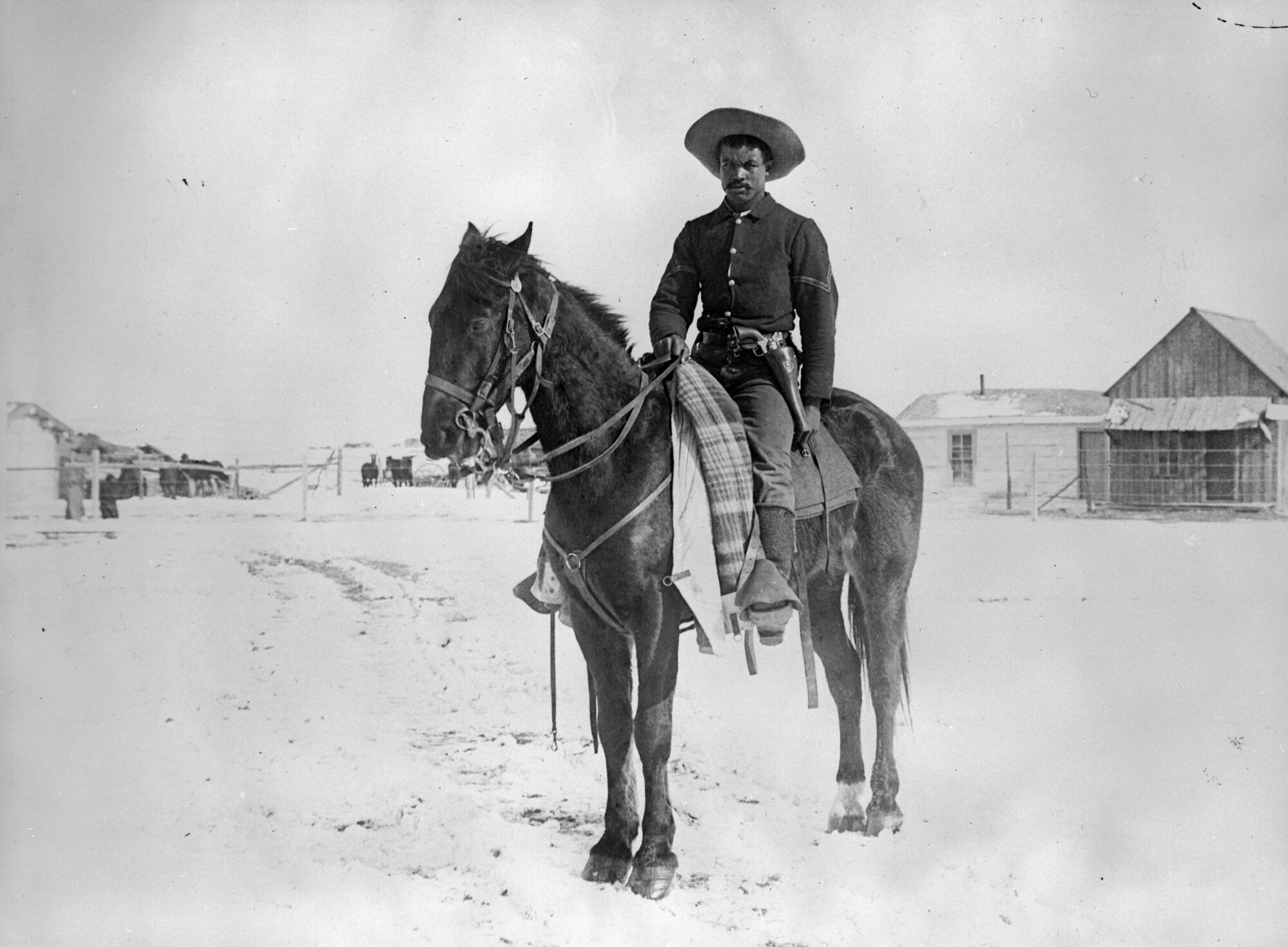
When people picture the American West, they often imagine a landscape shaped by railroads, boomtowns, and homesteads—but too rarely do they picture the Black soldiers who helped build, protect, and map that world in uniform. The Buffalo Soldiers—African American troops who served primarily in the U.S. Army’s segregated regiments after the Civil War—left a lasting imprint on the West, including right here in Colorado. Their story is one of discipline and endurance, of community-making on the frontier, and of a military legacy that helped shape the broader African American experience in the region for generations.
Colorado and the Buffalo Soldiers: Presence on the Frontier
Colorado served as a strategic crossroads in the late 19th century, a place where federal military policy, western expansion, and local community formation collided. Buffalo Soldier regiments moved through—and at times were stationed in—Colorado and the surrounding territories as part of the Army’s effort to enforce federal presence across vast distances. Their duties were wide-ranging: guarding transportation routes, escorting supplies and officials, patrolling remote areas, and responding to conflicts that the federal government framed as “frontier security.”
In practice, that meant Buffalo Soldiers were often the visible face of the U.S. Army in towns and rural outposts alike. Their work helped stabilize travel corridors, protect infrastructure, and support the governmental systems that rapidly reshaped the West. In Colorado, this military presence also contributed to the social fabric of the region. Soldiers spent pay in local businesses, attended churches, formed relationships, and sometimes settled after service—adding depth to Black western life that is too often left out of popular narratives.
Influence on the African American Experience in the West
For African Americans in the post–Civil War United States, military service offered a complicated but real pathway toward wages, skills, mobility, and a measure of authority in an era of violent backlash and restricted opportunity. In the West, that mobility mattered. Service could mean travel, new networks, and access to places where Black communities were smaller but also more connected to the evolving possibilities of western life—work, land, and civic participation.
At the same time, Buffalo Soldiers carried the heavy contradictions of the era. They served in segregated units and faced discrimination within the Army and in the towns where they were stationed. They were asked to enforce federal policy in contested spaces, even as they themselves navigated a nation that denied them full equality. That tension—service alongside exclusion—shaped the lived reality of many Black soldiers and the communities that formed around them. Their presence in the West helped expand what “African American history” looks like geographically: not only Southern and urban, but also western, rural, and deeply tied to the military footprint of expansion.
A Military Legacy That Echoes Forward
The influence of the Buffalo Soldiers stretches far beyond the 19th century. Their service helped establish a tradition of Black military professionalism that later generations drew upon—through World War I and II, into the fight for desegregation, and onward to the modern U.S. armed forces. Their example challenged prevailing myths about Black capability and leadership, even as the Army’s policies tried to confine Black advancement.
Equally important is the legacy of community memory: the stories passed down through families, the pride connected to uniforms and service records, and the ways Black veterans have long anchored civic life—building institutions, mentoring youth, and insisting on recognition. In Colorado and across the West, that legacy continues to shape how African American communities understand belonging, contribution, and the right to be remembered as part of the region’s history.
New to BCL: Buffalo Soldier Items Added to the Collection
We’re honored to share that Blair-Caldwell Library (BCL) has recently acquired some Buffalo Soldier items that will be added to the BCL collection. These materials are more than artifacts—they are touchstones. Items like these help transform history from something abstract into something visible and human: proof of lived experience, of daily service, of identity carried in fabric, metal, and personal effects.
As these items are processed and made available, they will support researchers, educators, students, and community members seeking to better understand Black life in the West and the long arc of African American military service. They also strengthen BCL’s ability to tell a fuller Colorado story—one that recognizes Buffalo Soldiers not as footnotes, but as builders of place, participants in local life, and inheritors (and makers) of a legacy that still resonates.
Why It Matters Now
Remembering Buffalo Soldiers is not only about the past—it’s about accuracy, inclusion, and honoring the people who stood in the gap between opportunity and exclusion and still carved paths forward. In Colorado, their imprint can be traced through military history, community formation, and the broader Black western experience. With this recent acquisition, BCL is proud to help preserve that imprint—and to invite our community to learn, reflect, and carry the story forward.
Watch for upcoming updates about access, display, and programming connected to these new Buffalo Soldier collection materials.
Comments
“Black Regulars in the…
“Black Regulars in the Frontier Army” Examining America’s Most Misunderstood History
By Bill Gwaltney
Retired
• The National Park Service
• The National Museum of African American History & Culture
(Smithsonian Institution)
• The American Battle Monuments Commission
The story of Black soldiers in the Post-Civil War military of the United States is fraught with all manner of problematic issues from the mythology of Westerns to Hero Worship, and from well meaning but incredibly awkward amateur writing and even the legacy of Bob Marley’s Reggae masterpiece, “Buffalo Soldiers.”
Hollywood films with fanciful uniforms, the omnipresent Yellow Neckerchiefs, Winchester Lever Action Rifles in the hands of soldiers, and an insistence on the unbelievable has welded many Americans to a West that never was.
Recent enthusiasm for the idea of women serving as “Crypto Soldiers” in the Frontier Army, specifically the over-told and under researched story of William Cathay, have undermined interest in actual research in the search for a West that more closely aligns with our sense of modernity and magnanimity.
Cathay, a man known to have worn women’s clothing years after his service in the Civil War and Post Civil War Army has created new mythologies that have joined with older ones to form a historical version of the Gordian Knot.
Relatively recent films such as Danny Glover’s “Buffalo Soldiers” attempt to portray Black Troops as being in a place where they can make Socio-Political decisions about American Indians in the 19th Century West with no policies from the Army and no commands from White Officers in ways far more suited to the 1960s than the 1860s.
These elements all combine to divert attention away from the real service, the actual legacy and the ongoing contributions made by African Americans taking part in U.S. military operations in the West.
In truth, their mission was exceedingly similar in most respects to those given to their white counterparts.
The stories about how they were given inferior horses, uniforms and firearms turn out to be incorrect and even famed Buffalo Soldier Historian William Leckie apologized to me for having made this mistake early in his career.
What was different about their time in the Frontier Army was the reality of the Racism that they endured, and how they performed their duties in spite of daily and ongoing prejudice.
The concept of Federal Government military service combined with the idea of frontier combat against Plains Indian people and the Apache provide important parameters for their Frontier service, and illustrates the peculiar racial barriers experienced by Black troops in the American West.
In the end, not only is the service of these Black soldiers, Cavalry and Infantry, important as historical mile posts, but the Army gave them an important opportunity not only for regular pay and accommodations but forced these men to be seen as American citizens in the age of Jim Crow.
They were able to gain an education at the taxpayer’s expense, become leaders in an increasingly modernized military and serve as the nation’s first African American Civil Servants with access to Retirement and even the Old Soldier’s Home, even if it was, like the rest of the nation, segregated at the time.
In 1866, tired of one kind of war, the United States focused on westward expansion.
American Indian tribes, bent on preserving and reclaiming their way of life, renewed their resistance and proved a significant barrier to settlement of the west by whites.
In the same year the Black regiments were formed.
The Plains Indian had possessed the horse for at least a century and a half, and many had guns for generations.
The U.S. Army had just emerged from a Civil War that pitted large armies of infantry and cavalry against each other in a style reminiscent of the tactics used in the days of Napoleon.
The Army and the many Nations of Plains Indian peoples would clash in fighting that would extend for over forty years.
Plains Indian warriors were experienced horsemen and this skill, in combination with proficiency with lance, bow and arrows, made them formidable opponents for an army unused to mounted guerilla combat.
Plains Indians also enjoyed the firepower made possible by guns obtained by trade or by gift. Some were annual annuities from the Department of Indian Affairs or taken as trophies in combat.
How Plains Indians viewed Black soldiers may best be seen through their language.
The Comanche called them. "Tu Escapana" which translates as black soldiers.
The Lakota might call them; "Wasichu Sapa," which means Black White Man.
"Buffalo Soldiers" were ordered to place non-treaty Indians on reservations, where they often starved.
Black soldiers would be ordered to hunt them down and fight them if they refused to stay.
Understandably, Indian people viewed the Black soldiers as enemies.
A Ute warrior was quoted as saying;
"Indian no like Black soldier. Indian heap shoot."
Jason Benitez, an Apache remembered the men of the Black regiments quite differently;
"...we were living contentedly at Warm Springs, the
agency being garrisoned by a troop of Negro cavalry with whom we were on friendly terms."
The Black soldier saw Indian peoples through a lens clouded by the dangers of his job, real and imagined, and by the expectations of White America.
Some historians have suggested that Black soldiers
were expected, and perhaps even encouraged, to participate in anti-Indian prejudice to help maintain a racial order with American Indians at the bottom.
Today, some Americans wish to perceive that "Buffalo Soldiers" and American Indians had more in common than did Black soldiers and White
Americans.
While this perception is understandable, there is
nothing in period documents to suggest that Black soldiers felt any particular political solidarity with the people they were sent to fight.
A primary motive for the "Buffalo Soldiers" seems to have been to gain the respect of White Americans through military service and gain the rights of citizenship for black Americans through that respect.
Private Jacob Wilks of the Ninth U.S. Cavalry reveals the bitter reality of war when he recalled events of the 1874 Red River Campaign against the Comanche in the Texas Panhandle;
"We destroyed everything...in their village.
They had a good many guns, mostly citizens rifles,
and a good supply of ammunition besides bows, arrows, quivers, lances, etc...Their tents were made of poles over which hides were stretched, and these were burned...”
To some extent, in peacetime, the Black soldiers could view Indians in much the way Sgt. Niehaus of the white 10th Infantry did while serving at Ft. Union, New Mexico when he said;
" The soldiers did not hold hard feelings about
the Indians: I could always make friends with
them when they were treated right."
After four years of bloody Civil War, America turned its attention once again to the West.
The nation wanted to reduce its standing Army yet wanted to make westward expansion possible in the face of renewed Indian resistance against the inevitable tide of American emigration.
Beginning in 1866, large numbers of African Americans were recruited and served as regular soldiers in a changing west.
Freed by the 13th Amendment, these men served proudly on the western frontier because they thought that their military service would make white America see the sons and daughters of slaves as equal citizens under the law.
While being an enlisted man was seen as a dangerous, unsuitable, and low-paying job by most native-born white Americans, African Americans and immigrants came to view the U.S. Army as a haven from poverty and as an opportunity for adventure, self-respect, advancement, and an education.
Likely dubbed "Buffalo Soldiers" by their Plains Indian opponents, Black troops took great pride in serving the republic that allowed them to fight for their future.
Like any number of Regiments, Troops, or Companies, they were often assigned difficult tasks in out of the way places, as was the case for White soldiers.
These men performed their duty in garrison and in the field in segregated regiments under white officers.
They attempted to place Plains Indians on reservations, maintain a quiet border with
Mexico, arrest whiskey peddlers and unauthorized settlers, and capture thieves and outlaw gangs.
As the West changed, they changed with it, hunting poachers and fighting fires in America's new national parks.
They did not fail to take advantage of the opportunities offered them and they earned an enviable service record with the highest level of re-enlistments and the lowest rates of desertion in the entire frontier army.
Because they were different, they had a frontier experience different from other soldiers. Because they were Black they were called many names; the name that they could have been proudest of was "BUFFALO SOLDIERS."
But how did the name come about?
We know that as early as 1871, some Southern Plains tribe, probably the Kiowa, called the Black Cavalry soldiers "Buffalo Soldiers."
Some writers have suggested that the name was given as a mark of respect due to the important status of the buffalo, others have suggested that the name reflects the bravery the bison shows when cornered.
Yet others have suggested that the black soldiers got their name from the Buffalo fur overcoats issued to all soldiers in frigid climates beginning in the 1880's.
Neither of these concepts, nor others that are even more far-fetched, are supported by the facts as we know understand them.
The only real evidence of the origin of the name we have is from the pen of an army wife.
In 1871, Frances M. Roe wrote a letter from Fort Supply in what is today Oklahoma giving us our only documented glimpse of how the name came to be.
"The officers say that the negroes make good soldiers and fight like fiends....The Indians call them "buffalo soldiers," because their wooly heads are so much like the matted cushion that is
between the horns of the buffalo."
Over time, this name seems to have become used in popular culture for all the Black regiments, Cavalry and Infantry, that served on the frontier between the creation of some of these regiments in 1866 and the last days of combat in 1891.
Elizabeth Custer, wife of Col. George Armstrong Custer, said of the Black Troops; "They were determined that no soldiering should be carried out in which their valor was not proved."
In matter of fact, we have very little evidence that they called themselves by this name.
At the end of the Civil War, the United States Army numbered over a million men. Within a year, the Army was reduced to a mere 30,000 men.
The aftermath of war required a new kind of professional soldier to carry out the Congressional mandate for political change in the South and to forcibly place American Indians on reservations in the west.
To deal with the need for soldiers in the west, a bill was passed in Congress in 1866 that would expand the U.S. Army to nearly 57,000 men and create six new regiments to be made up of black enlisted men.
These new regiments would be the 9th and 10th Cavalry and the 38th, 39th, 40th, and 41st Infantry Regiments.
When it comes to terminology, I should point out, as did an old and retired Sergeant Major from the 10th U.S. Cavalry did for me years ago, that:
“Cavalry is a Soldier on a Horse, while Calvary is Christ on a Cross.”
Immediately after the end of the Civil War, a third of the entire U.S. Army was assigned duty in the South.
As a result, there were never enough soldiers in the west and the political machine of the southern Democrats soon found a way to reduce the size of the Army to reduce the hold of the Federal Government in former Confederate States.
In 1869, the Army was reduced again, this time by 20 regiments of infantry.
In the same year, the four black infantry regiments were consolidated into the 24th and 25th U.S. Infantry Regiments.
Over time, the army shrank to a skeleton of 27,000 enlisted men. Because of illness, death, desertion, and completion of enlistment, the actual number of men available for duty would dip as low as 19,000.
During the period known as "The Indian Wars" (1866-1891), over 10,000 black men served in the segregated frontier regiments as did several hundred White officers.
It is worth pointing out that the US Army provided employment for African American males in an era increasingly controlled by Segregation and “Jim Crow” Politics.
For African American men, being a member of one of the all-black frontier regiments meant regular pay, advancement, self-esteem, clothing, and medical care.
It was, perhaps, the best job and the only career available at the time.
A soldier could even retire after 30 years to Soldier's Home in Washington, D.C., although, like the rest of the country, it was segregated.
No black sharecropper in the south could dream of being as secure as a 13 dollar a month private in the regular army.
"Buffalo Soldier" recruit Charles Creek was sure the Army was a better choice that sharecropping.
"I got tired of looking mules in the face
from sunrise to sunset, [I] thought there must be a better livin' in this world."
One of the most rewarding, if unexpected, benefits of the frontier military was that Black men were encouraged to gain a basic education.
In 1870, the Army Inspector General complained that the illiteracy of black recruits constituted a "great labor thrown upon the officers of the colored regiments in being obliged to make all rolls, returns, accounts and keep all books with their own hands."
The Army wanted to educate black men in the basics so they themselves could prepare the many printed forms and reports that the military bureaucracy required.
The 1866 legislation that created the Black units included a special provision that assigned a Chaplain to each "Buffalo Soldier" regiment.
Such chaplains were not ordinarily an official part of the organization of White regiments.
Regimental chaplains were to look after the spiritual and educational life of the men in these Black regiments.
The feelings of the "Buffalo Soldiers" about their lives and their careers is apparent in an 1877 report by the White Chaplain of the 25th Infantry.
The Rev. G. G. Mullins wrote;
"The ambition to be all that soldiers should be is not confined to a few of these sons of an unfortunate race.
They are possessed of the notion that the colored people of the whole country are more or less affected by their conduct in the army.
The chaplain is sometimes touched...by their manly anxiety to be well thought of at Army [Headquarters] and throughout the states."
When the Black regiments were formed, it was expected that, as was the case during the Civil War, only White officers would lead them.
The common wisdom of the day dictated that Black soldiers could only succeed if they were led by White officers.
This same logic held that if Black soldiers showed bravery under fire, it was due to their "natural savagery" and if they failed in combat, it would prove their "natural cowardice."
The lives of these soldiers would be difficult, and so would the lives of the men who had accepted commissions as officers to lead them.
The men of the Black Cavalry regiments were lucky to have extraordinary officers appointed as their commanders.
The Colonel of the 9th Cavalry would be dashing Civil War hero Edward Hatch.
During the war, Hatch had participated in a daring raid through Confederate occupied Mississippi under the man named to lead the 10th U.S. Cavalry, Colonel Benjamin Grierson.
Grierson and Hatch were both veterans of training and organizing men and leading their soldiers in battle.
The recruiting officers worked hard to secure sufficient numbers of men to fill the ranks, but a recruiter in Boston was reminded by Colonel Grierson that he should,…
"Endeavor to secure the best material, as the quality is more important than the numbers."
Grierson made enemies for himself among fellow officers, but friends among the men of his regiment when he insisted that the word "Colored" would not be attached to his regiment but that the name would be the 10th U.S. Cavalry, period.
Many of the Army "Brass" including General William Tecumseh Sherman, originally doubted that Black troops would make good soldiers.
Some officers refused a posting to a Black regiment out of blatant racism or from fear of serving their entire career with Black troops.
Veteran Army Officers George Armstrong Custer and Eugene A. Carr, both took equivalent or lower ranks in other regiments rather than serve with Black troops.
As the Black recruits drilled for days on end at recruiting depots, they began to take pride in the soldiers they would become, as did their officers.
Company Commanders, usually Captains, were responsible for the readiness of the men in garrison and in the field.
It was the job of the officer to drill the men, inspect the food, supervise their fatigue duties, and lead them in combat.
The Officers who served with Black troops defy easy description.
Some were Civil War veterans who enjoyed the "Glittering Misery" of the privileged army life of an officer.
Others were West Point graduates who were posted to the west in increasing numbers.
Some were kind men who cared about the future of the black enlisted men under their command, while others where bullies, given to fits of drunken rage and racist, sadistic displays of their power.
Colonel Wesley Merritt of the 9th Cavalry criticized Lieutenant Heyl of the same regiment for being,…
"...much to blame for cruel, not to say brutal, treatment of his men."
24th Infantry Lieutenant Charles Crane treated his men with respect and an obvious pride.
Crane remembered;,
"...though I had not desired the colored infantry,...I have never regretted my service in that regiment."
John Bigelow. once a Lieutenant in the 10th U.S. Cavalry, was less kind in his reminiscences.
"For over twenty years, I labored under the
disadvantage of serving in a colored regiment."
Regardless of their personality, and sometimes despite themselves, the white Officers who served with "Buffalo Soldier" regiments shared a special bond with their men.
Because they led Black troops, they, too, knew the stigma of racism.
Captain George Armes of the 10th Cavalry remembered being ordered to;
",…attend dress parade with my company, and after forming a line close to the white troops, (another
officer) came down and ordered them at least ten or fifteen yards to the left, saying I must not bring my nigger troops so close to his
white ones."
General William Tecumseh Sherman admitted he had sent black soldiers to Texas because he felt that they could better endure extremes of temperature.
When Black soldiers succeeded in their difficult mission, in spite of their supposed, "natural inferiority and lack of leadership ability", it was often attributed to the leadership of their White
officers.
Many officers were justifiably proud of what they and the men of the "Buffalo Soldiers" were able to accomplish.
"I cannot speak too highly of the conduct of the
officers and men under my command, always cheerful and ready, braving the severest hardships with short rations and no water without a murmur.
The negro troops are peculiarly adapted to hunting Indians knowing no fear and capable of great endurance"
Major Albert P. Morrow
9th U.S. Cavalry
Powhatan Clarke was a competent officer who was popular with his men.
Clarke was awarded The Medal of Honor for braving a deadly fire to rescue an injured "Buffalo Soldier" during a fight with Apache warriors.
Genial and efficient, Clarke tragically drowned when crossing a swollen river with his Troop.
The Company commander of Troop "A" of the Tenth Cavalry, Captain Nicholas Nolan saw action with his men for decades from the Red River War to the Victorio Campaigns.
Lost in the "Staked Plains" of the Texas Panhandle for days without water with his men, Nolan shared their desperate struggle for survival.
A hard-driven leader and at the same time, an open minded moderate, Nolan was respected by his men as an honorable man and an excellent Officer.
This presentation would be less than complete if I did not mention:
LT. HENRY OSSIAN FLIPPER.
The first African American to be Commissioned an Army Officer, Flipper had been born enslaved in 1856,
Henry Flipper obtained an excellent education before entering the U.S. Military Academy in 1874.
After four grueling years of schooling made even more difficult because of his race, Henry O. Flipper became the first African American to graduate from West Point.
He was assigned as a Lieutenant with the 10th Cavalry and stationed in Indian Territory
and West Texas.
Flipper was for years the only Black officer in the United States Army.
In 1882, Flipper was dismissed from the Army on charges he maintained were trumped up by White officers to ruin his career.
Flipper continued to be a pioneer in many areas and served as a mining and civil engineer in Central and South America, a Spanish scholar, Nogales, Arizona newspaper editor, Treasury Department Special Agent, and as Assistant to the International Alaskan Engineer Commission.
He died in 1940 after decades of unsuccessful attempts to clear his name.
CHAPLAIN HENRY V. PLUMMER
The US Army appointed its first African American chaplain in the Regular Army in 1884, when Henry V. Plummer was named to teach and preach to the men of the 9th Cavalry.
Born a slave, Plummer was a veteran of the U.S. Navy in the Civil War. In 1879, Plummer graduated from a Washington, D.C. seminary and served as a Baptist pastor.
The first African American Chaplain named to work for the Frontier Army, he served for a decade at posts in the west.
Plummer's duty with the Ninth took him to Kansas, Wyoming, and Nebraska.
Plummer was an able Superintendent of post schools at Ft. Robinson, Nebraska, and encouraged enlisted men to take up education and turn away from the frontier vices of whiskey and gambling.
While not a serving Officer in the same way as Flipper, Plummer would have enjoyed the same basic rank, housing, and privileges as an Army Major.
Plummer also opposed the sale of beer and wine on Army posts, which challenged the long-standing practice of the frontier and one of the few pleasures of the enlisted man.
Friction between Rev. Plummer and White officers soon developed over housing discrimination and social reform.
Following allegations of fraternizing with enlisted men, Plummer was charged by White officers with behaving in "a disgraceful manner."
Even though segregation made it impossible for him to socialize with other officers, Plummer was dismissed from the Army for "undue familiarity with the enlisted men."
In the frontier Army, a Black man might find a sense of freedom and self-respect that seemed hard to come by in the Old South.
If he learned the job of a soldier well enough, was able to read and write, and had earned the respect of the Officers of the regiment, a man might be promoted from the ranks.
An enlisted man could hope to be promoted to the ranks of Non-Commissioned officers.
These Sergeants or Corporals were the backbone of the Army, and where selected, in part, because of their toughness. Woe to the private who got out of line.
Sergeants would take over many of the day-to-day responsibilities of managing the platoon or occasionally the entire Cavalry Troop or Infantry Company.
Sergeants might conduct regular roll calls, assign daily duties, make written reports to the company commander, and rarely, lead troops on patrol in the field.
A Corporal might be called on to drill the men, supervise work parties, or assist men in drawing rations or ammunition.
It was a proud day when a "Buffalo Soldier" sewed on the new chevrons and trousers stripes that made him part of this special fraternity of men of bronze.
Some of the best Army jobs for black enlisted men were Staff Non-Commissioned Officer positions.
Being named a Staff N.C.O. meant better pay, shorter hours, a more comfortable job, additional power, and prestige, and often the Army's permission to finally have a family life.
The job also demanded a high level of literacy.
A Post Commissary Sergeant looked after the paperwork and procedures that kept the men and the officers of the post fed.
Every few days, men from each Infantry company or Cavalry troop would report to the post Commissary where the Sergeant might dole out the rations himself.
The Regimental Quartermaster Sergeant managed those things that helped the army do its job.
These included tools, uniforms, tents, and camp gear, and could range from hay for horses to coffins for the dead.
An Ordnance Sergeant was responsible for keeping track of a regiment's rifles, or pistols and carbines, along with ammunition and the occasional artillery piece.
All of these men were saddled with the responsibility of reams of paperwork that was often tied up, literally, with lengths of red tape.
The top N.C.O. post was that of Regimental Sergeant Major.
The man in this position supervised the other staff NCOs and acted as the Chief Enlisted Administrative Officer.
Such a man was important and was often seen as indispensable to White officers as a bridge between them and the men of the Black regiments.
When it came to the day to day work of a Soldier, Artist Frederic Remington reminds us that,…
"Soldiers, like other men, find more hard work
than glory in their calling."
Except for racism and the violence that often came with it, "Buffalo Soldiers" lived a life very much like that of their white counterparts.
A frontier soldier's biggest enemies were boredom and monotony.
After the hard work of locating and building an Army post, a soldier could expect a never-ending year-round cycle of drill, practice marches, and guard mount.
Officers assigned enlisted men to daily chores called fatigue duty.
Fatigue might include mopping the barracks, cleaning out the stables, getting rid of garbage, cutting firewood, hauling drinking water, or painting post buildings.
Perhaps even more hated were duties such as taking a turn as cook or as kitchen helpers called the "Cook's Police."
Soldiers had to prepare their meals from unpalatable and unhealthy rations such as greasy salt pork, moldy flour, and mouse-chewed beans.
Kitchen duty involved long hours and was difficult, messy, and frustrating when fellow soldiers often proved ungrateful.
The Army also called upon frontier soldiers to perform extra duty assignments such as heavy construction, road building or erecting telegraph lines.
Soldiers were supposed to get extra pay for some of these duties, but they were sometimes denied the money under various pretexts.
One way a Soldier could make some extra money was to act as a personal servant to an officer.
The soldier would be paid out of the Officer's pocket and was often able to escape fatigue details and other unpleasant assignments.
Called "Strikers" or "Dog Robbers" by their fellow soldiers, these men had the added benefit of getting food left over by the officer, and sometimes being able to gain the sympathy, if not the friendship, of the officer himself.
Unable to provide wholesome food, the Army encouraged soldiers to grow vegetables from seed in company, post, or hospital gardens as an official part of their job for the company mess table.
Extra vegetables and other surplus food was generally sold and the money was placed in a "Company Fund."
This fund was used by the men to purchase more vegetable seeds, canned foods, sports equipment, books and magazines, condiments, and even to have dinner China produced with the company emblem monogrammed on it.
One company of "Buffalo Soldiers" even voted "Company Fund" monies to "adopt" a soldier retired from the ranks who had become disabled after being injured in a hunting accident.
When men received their usual pay every two months, the Army deducted anything owed to company laundresses, the post sutler, or for government property lost or damaged by the soldier.
Soldiers, black or white typically spent what was left of their pay on drink, prostitutes, and gambling.
In addition, soldiers on the frontier acted as their own sentinels, fire department, and military police.
Like the rest of the Army, the men of the "Buffalo Soldier" regiments had to take turns on Guard.
Assigned to a 24-hour stint, the soldier donned his dress uniform and joined a group of fellow soldiers to be inspected first by the Company First Sergeant, then the ranking post non-commissioned officer, and finally by the officer of the day.
The previous day's Guard was relieved with as much military pomp and circumstance as conditions would permit and then the "new" guard would be marched to their posts.
Because very few frontier posts were surrounded by walls, one of the primary jobs of the guard detail was to prevent unauthorized persons coming on to the post and keep soldiers from deserting or "going over the hill."
Soldiers marched a "beat" for as much as four hours at a time without relief.
A soldier on guard detail had to be always ready and even slept in his full-dress uniform.
This ceremonial part of army life was detested by soldiers as difficult, monotonous, and useless.
The Army did not agree. A soldier found asleep at his post could be executed under the military laws contained in the Articles of War.
Even before the end of the Civil War, the Army began to experiment with new firearms technology that utilized fixed metallic cartridges to replace single shot muzzleloaders.
The experiment was a success and beginning in 1873, a new issue standard firearm began to see use.
Infantry soldiers used a Springfield Trapdoor Rifle that fired a .45-70 caliber cartridge. The Cavalry fired a shorter carbine version of the same gun, but with a cartridge in the same size loaded with a slightly less gunpowder.
While legend has "Buffalo Soldiers" getting "hand-me-down" surplus equipment, we now know that all Troops of the 10th Cavalry had received new carbines and revolvers by the end of June, 1875, in keeping with the issue of the same arms to other regiments.
The defeat of Lt. Colonel George Armstrong Custer's Seventh Cavalry in 1876 made many Army officers take a new look at the need for marksmanship training.
By 1879, the Army had finally adopted a systematic approach to target practice and increased amounts of time and ammunition were expended in the training of soldiers.
Many black soldiers had been born enslaved and therefore had little prior experience with firearms.
Like the rest of the Army, they soon became caught up in the rage for long range marksmanship and the special privileges that being a top regimental or departmental shooter would bring.
Perhaps "Buffalo Soldiers" just enjoyed competitive target shooting, but in marksmanship, they knew that race could not be held against them.
When they succeeded, they had to know that it was because of their skill, and that could bring a recognition that no amount of racism could tarnish.
"My first target practice with the rifle was at San Carlos...it was the first time that I had ever shot a rifle.
I made sharpshooter in that year,...and have
ever since led my troop in marksmanship.
I represented my troop,...winning eight medals and badges at the department competition."
Sergeant Horace Bivins
Troop I - 10th Cavalry
When not in the field or on detached duty for various reasons, soldiers called a barracks home.
Large, uncomfortable, and often poorly built structures, Barracks were usually hot in the summer,
and cold in the winter.
Each Infantry Company or Cavalry Troop was generally assigned a single Barracks.
Half would be sent to a squad room where the men would set up their few belongings on shelves and in foot lockers and arrange themselves along the lines of a "pecking order" peculiar to soldiers.
The more experienced men, nicknamed "Old Soldiers" regardless of their age, would often take the bunks near the windows in the summer and move near the wood burning stoves in the winter.
A fresh recruit, called a "Young Soldier" in the Black regiments, would have to make do with what was left.
A man's closest friend or most bitter enemy was his "Bunkie." Until 1871, two soldiers literally shared a pair of blankets to conserve heat and save the Army money.
The U.S. Army finally purchased bunks that allowed each man to sleep in his own bed, but the term "Bunkie" continued to refer to the comrade in the next bunk, who might be a confidant, a friend, or a bully.
Corporals slept in the squad rooms, but First Sergeants were often able to live in a private room at the end of the barracks that served as their office and their bedroom.
A Black frontier recruit looked forward to the day when he would be honored with the affectionate title of "Old Soldier" and was accepted as a competent soldier in the ranks.
The Company Commander might occasionally enter the barracks to taste the soup or to conduct a Sunday morning inspection, but the Barracks was a place that belonged to the enlisted men.
To an "Old Soldier", it mattered less what the Company’s Captain thought, than what the rest of the men in the barracks thought.
The barracks was a place where men could read a newspaper, smoke a cigar, share a joke, or swap tales of past adventures in the field or misadventures at local off-post brothels and gambling dens commonly known by soldiers as "Hog Ranches."
Whether in the Army for a single enlistment or a 30- year career, the Barracks meant just one thing to a "Buffalo Soldier," it meant home.
The Army had to adapt, and sometimes discard, Civil War strategies to prevail on the frontier.
Able to move relatively fast, the Cavalry was supposed to locate, surprise and rout Indian bands.
It seldom seemed to be as simple in fact.
Indian warriors were courageous, skilled, and took advantage of every military opportunity that presented itself.
They would then slip away without an easily followed trail to fight again.
Indian ponies were able to go farther, travel longer, and prosper on grass far better than Army horses could when fed on grain.
After a few days in the field, the Cavalry could be matched and sometimes beaten by the hard-marching men of the Infantry.
If the men of the mounted regiments could not keep up with the foot soldiers, they could hardly be expected to catch mounted Plains warriors.
On the Plains, the Cavalry had to change tactics and act as a sort of mounted Infantry to be effective.
Riding into combat, the mounted soldier would be ordered to halt and dismount. One soldier out of four would link the four horses by means of leather "link straps" and lead them out of harm's way.
The dismounted cavalry would advance and fight on foot with carbines.
Occasionally, there might be a mounted charge with saber and pistol. Seeing the futility of carrying a saber in combat against expert guerilla fighters, many officers soon allowed the men to leave them in the barracks.
The job of a frontier "Buffalo Soldier" was made even more difficult because of the nature of "policing the plains."
Changing presidential administrations and conflicting federal policies made soldiering confusing at best.
Politicians were sensitive to the feelings of the newspapers and the voters, but seldom considered the plight of Plains Indian peoples.
The "Buffalo Soldier" found himself placed squarely in between.
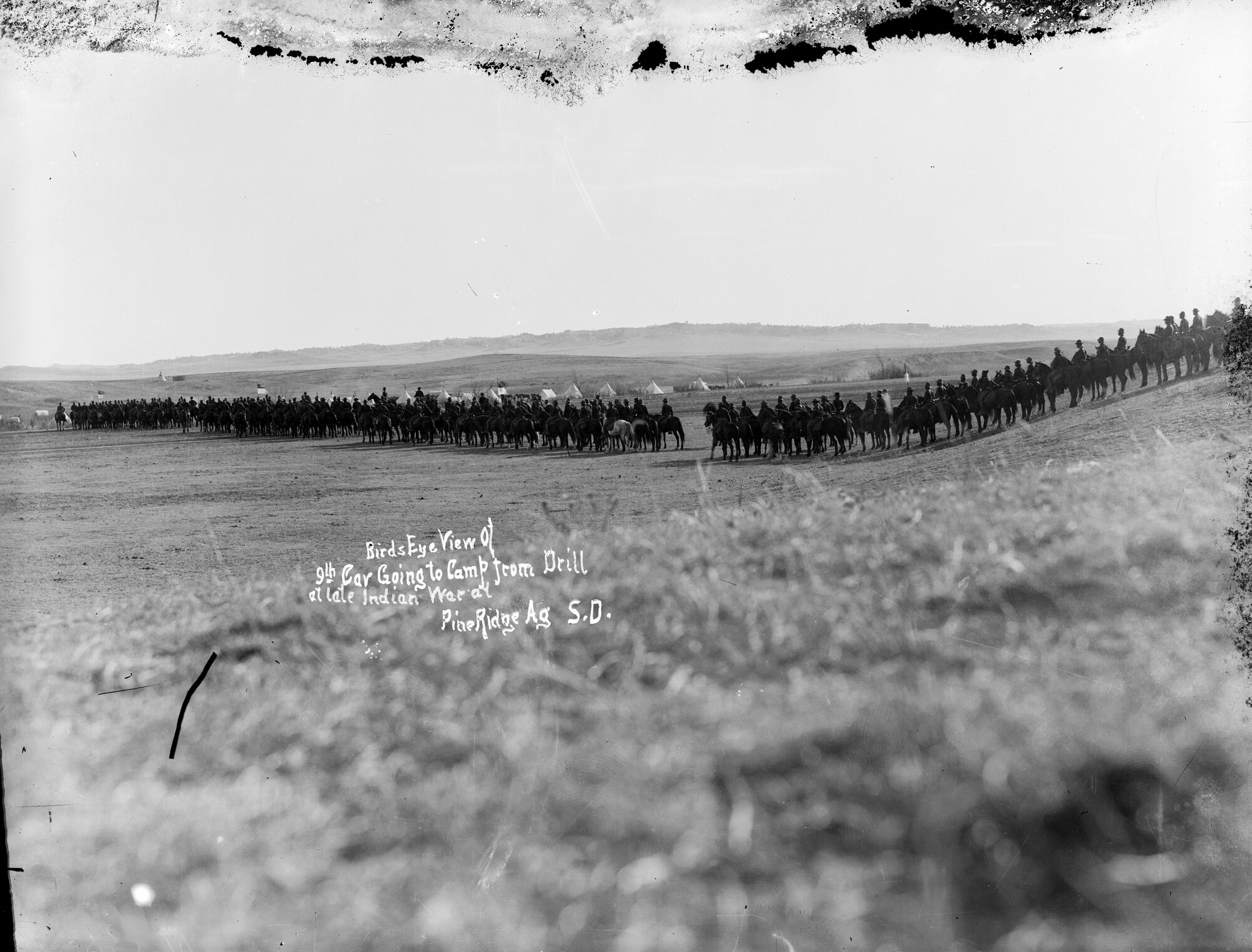
In 1890, units of the 7th Cavalry were pinned down by Lakota (Sioux) marksmen the day after the slaughter at Wounded Knee.
A messenger was sent for help, and after a forced march from Nebraska in freezing temperatures, Troop “K” of the 9th Cavalry rode to the rescue at Drexel Mission and drove off a large party of Indian warriors.
These black soldiers could not know it at the time, but they had participated in the last major fighting of the Indian Wars.
On that frozen battleground, they had witnessed the passing of a way of life for many Indian peoples, and the end of the American Frontier.
The endless drudgery of life in garrison was occasionally broken by the sheer terror of combat.
The average soldier never heard a shot fired in anger, but those that did never forgot the sound of it.
The job of a Soldier was to do the bidding of the political leaders and the citizens who demanded that Indian peoples be moved from lands that they had loved and lived on for ages.
It would be a dirty business.
When the orders came for the men to prepare for a campaign in the field, the experienced men knew what to do.
They found ways to obtain an onion or a potato to augment their scanty field rations of salted beef or pork, dried "desiccated" vegetables, beans, and coffee.
Soldiers packed their food ration in canvas haversacks, filled their canteens and stuffed their ammunition belts with cartridges.
The frontier soldier had to rely on a minimum amount of gear.
Traveling light meant a soldier carried a half tent barely five feet long, a single grey or blue wool blanket, a rubber coated cloth poncho, mess gear and very little else.
The Plains tribes that they fought were highly skilled as both warriors and tacticians.
When fighting began, Indian warriors often had a decided advantage and fought on ground of their own choosing.
The Indian advantage in tactics could sometimes be overcome by the firepower superiority of the Springfield rifles and carbines carried by the soldiers.
Combat was often fierce, confusing, and was often over almost as fast as it began.
The grueling marching on lean rations and in difficult weather could seem to go on forever.
While the Cavalry could travel in a little more comfort than the Infantry, after a few days on campaign, after a few days of campaigning, the foot soldiers could often out-distance the mounted troops.
When an infantryman finally got to camp, he and his "Bunkie" could set up their "Dog Tent", while the cavalryman still had to care for his horse before he could fall exhausted into his blankets.
At the end of a long march,...tired, sore, cold, wet and hungry, the men of the Black regiments knew that it was this difficult duty that earned them their Thirteen dollars a month.
What is now Colorado was the scene of some of the earliest action involving the black frontier regulars.
Troop "I" of the 10th Cavalry fought against a force of 100 Cheyenne near Big Sandy Creek in September of 1868.
The men dismounted and fought against the much larger Cheyenne force.
Later that year, a party of white soldiers and civilian scouts under Major George A. Forsyth were surrounded and besieged by a large force of Cheyenne warriors.
They took refuge on a small island in eastern Colorado.
When word got out that the men needed help, Troops "H" and "I" of the Tenth Cavalry were part of the force that rode to relieve the troops at the place known ever since as "Beecher Island."
Making a forced march from Cheyenne Wells, Colorado, and “Buffalo Soldiers” of Captain Louis Carpenter's Troop "H" drove off the party of warriors and gave vital assistance to the sick, injured, and starving survivors.
Private Reuben Waller of Troop "H" fought in the engagement and lived many years to the age of 105.
Even after 70 years, he remembered the rescue vividly. He described the "great sensation" the rescue caused and how the survivors greeted the black soldiers.
",…there went up a cheer that made the valley ring,
and strong men grasped hands, and then flung their arms around each other, and laughed and
cried."
Perhaps as telling as the emotional welcome the men of the 10th got was a secret party hosted in their honor by the Beecher Island scouts near Pond Creek.
The party refused to honor the unofficial policy of segregation then so popular in the United States.
Still, at Pond Creek, there was little chance of being discovered.
The Scouts shared their thanks and their whiskey with the Black soldiers.
Rueben Waller would remember;
" They sure treated us black soldiers right
for what we had done for them...The scouts
would have us drink, and we did not resent
their courtesy."
Between 1875 and 1875, black soldiers from the 9th Cavalry were stationed at Fort Garland in southwestern Colorado.
This post was described by one observer as;
"a rectangular group of adobe buildings, flat roofed,
squat, and altogether dispirited in their unmitigated
ugliness, with the United States flag clinging to a
central pole."
Despite this uninviting air, the men of the 9th Cavalry performed their duty well.
Black troopers from Ft. Garland spent time away from the post engaged in such duties as removing white settlers from the Ute Reservation and providing security during disputes over treaty violations committed by white miners and settlers in Colorado.
By 1879, Company "D" found themselves on the march again, this time to patrol out of a base camp at Middle Park.
Indian Agent Nathan Meeker sent word that trouble was imminent at the White River Indian Agency and troops from Ft. Fred Steele in Wyoming were dispatched.
When the message arrived in Middle Park, Captain Frank Dodge and "Troop "D" saddled their horses and made the ride towards the Agency.
En route, they came across the soldiers from Ft. Fred Steele.
The Wyoming soldiers had run into Ute warriors who considered their presence an act of war.
The soldiers were pinned down for six days and nights. Joining the fray, Troop "D" boldly rode into the rifle pits and got in on the fighting.
Captain Dodge stated that his "Buffalo Soldiers" had asked to charge the Indian position but were not permitted to do so.
The black soldiers fought alongside the beleaguered party for several days with little water and the stench of rotting flesh from the horses killed in the fighting.
Additional soldiers finally arrived on the 5th of October. Outgunned, the Utes wisely withdrew, ending the stalemate.
Captain Lawson of the original besieged party spoke volumes about the racial views of the day when he exclaimed about the black soldiers that rode to his rescue;
"[They] were the whitest men he ever saw..."
In the days after the Civil War, the frontier Army was a haven for Black men.
The Army had its doubts about what many considered a "social experiment."
At first, it must have seemed to many "Buffalo Soldiers" that racism was left behind many miles away, but it was not to be so.
Over time, the Army became a place where segregation was strictly enforced, and assignments were often guided by stereotypes and prejudice.
Hatred of black soldiers seemed at its worst in Texas, a state that had been part of the old Confederacy.
In the Lone Star State, black soldiers were sometimes unfairly denied rations and quarters and were refused rides on the same stagecoaches that they were assigned to protect.
When one stagecoach driver took a shot at a "Buffalo Soldier" near Barilla Springs, Texas in 1872, the Trooper coolly returned fire, killing his assailant.
In 1881, a "Buffalo Soldier" and a white soldier from another regiment were killed in separate shootings in San Angela, Texas.
Black and white soldiers banded together and had a poster printed as a warning to the citizens of the town.
" We, soldiers of the United States Army,
do hereby warn cowboys, etc., of San Angela
and vicinity, to recognize our rights of way
as just and peaceable men.
If we do not receive justice and fair play,
which we must have, someone will suffer,
if not the guilty, the innocent.
It has gone too far; Justice or Death.
U.S. Soldiers, one and all"
Racism did not exist only in Texas but sprang up all across the frontier as soon as the perceptions of danger from Indians had passed.
One resident of Middle Park, Colorado remarked that the black troopers assigned there in 1879 looked to him like; "a gang of negro minstrels."
One Black trooper, recuperating from injuries received in the line of duty, was ordered back to his duty station from the U.S. General Hospital at Hot Springs, Arkansas.
Because of his race, he was unable to purchase anything to eat or drink on the train or at the stations. The soldier went 48 hours without even a cup of coffee.
Even under the heavy hand of racism and the "Lynch Law," the men of the black regiments received high praise.
The 1889 Annual Report from the Secretary of War stated that black troops were: "...neat, orderly, and obedient, are seldom brought before court-martial, and rarely desert."
In most cases the soldier's response was not violence, but an attempt to vent his disappointment and defend his reputation as a soldier. One "Buffalo Soldier," Pvt. Thomas A. Ernest, wrote:
"... The Twenty-Fourth is one of the cleanest,
best drilled, and best disciplined regiments
in the United States...
The Negro is known for
his obedience to and respect for law and order,
...we object to being classed as lawless barbarians
We are proud of our regiment's reputation, and
[are] confident of our ability to maintain it."
Sgt. Barney McKay of Troop "G" of the 9th U.S Cavalry stationed at Ft. Robinson was more direct when he issued this warning to citizens of nearby Crawford, Nebraska.
"You lynch, you torture, and you burn Negroes
in the south, but we swear by all that is good
and holy that you shall not outrage us and our
people right here under the shadow of "Old Glory," while we have shot and shell, and if you persist... we will reduce your homes and firesides to ashes and your guilty souls to hell.
Perhaps the most eloquent reminder of the ugly stigma of racism on the frontier came from Private Edward A. Johnson who wrote;
"Let it be said that the Negro soldier did his duty under the flag, whether that flag protects him or not."
The men of the Black regiments faced danger in the field against skilled and wary Indian warriors intent on protecting their families, homes and way of life.
Buffalo Soldiers faced an even more implacable enemy: American Racism.
Even as they prevailed against American Indians, they lost the silent battle they waged for citizenship and civil rights.
A post-Civil War America, taken in by anti-black propaganda, offered limitless opportunity and freedom to immigrants and lent aid to foreign countries abroad while turning its back on African
Americans at home.
Racism became acceptable and laws were enacted
that legitimized segregation and oppression, turned a blind eye to racial violence, and denied black Americans their rights as citizens.
Congress considered de-authorizing black regiments while some White Officers freely quoted the dogma of White racial superiority.
A "Buffalo Soldier" had only two choices. He could quit in disgust and take up menial tasks in civilian life or stick it out and retire a soldier after 30 years.
One officer who remained loyal to the men of his Black regiment wrote what would become an epitaph for these Black Frontiersmen;
" All that men could do,...they did."
Eighteen Buffalo Soldiers received the Medal of Honor, then as now, the most distinguished recognition made to military personnel by the
Government of the United States.
These men were different not in their tasks, but in overcoming the barriers they had to overcome placed in their way by the Army, the
citizens of the west, and the people of the United States.
"Buffalo Soldiers" brought a new kind of diversity to the west. It was not just a diversity of names, faces, and skin colors, but a diversity of dreams and accomplishments against great odds.
They were many things, but one thing that was singular about them is that they were the first African American Civil Servants in the United Stated Government.
Some stayed after the fighting ended,...many did not.
In the end, they all contributed to the history of the American West.
"Nowhere were the qualities of instant courage, constancy under adversity, devotion to duty, and lasting loyalty displayed to better advantage in the Indian-fighting Army than among the Black Regiments."
Gregory J.W. Urwin, Ph.D
Author and Historian
Add new comment