
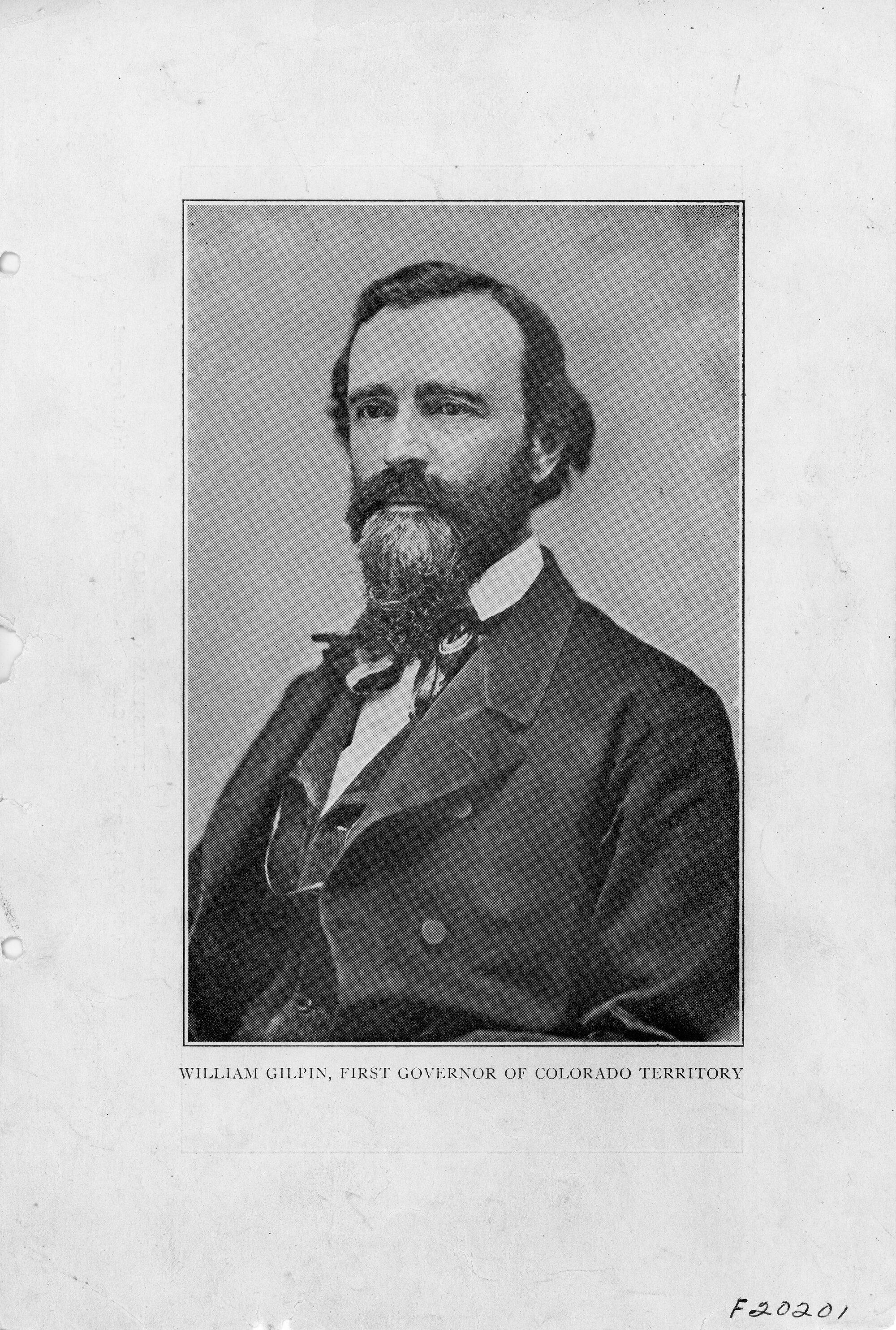
On 28 February 1861, the Territory of Colorado was established by an Act of the 36th Congress. The Colorado Organic Act set the framework for the temporary government of the territory. It established boundaries, developed the position of governor and its powers, and outlined the creation of the legislative assembly consisting of elected members of the council and the house of representatives.1 Before an election could be held, there needed to be a census of the population to determine representation. The requirement for the census is found in Section 4 of the Act:
Previous to the first election the governor shall cause a census or enumeration of the inhabitants of the several counties and districts of the Territory to be taken[.]2
The newly appointed Governor William Gilpin arrived in the Colorado Territory by express coach on the afternoon of 27 May 1861.3 The census was Gilpin’s priority. The following Thursday, 30 May 1861, just three days after his arrival, Governor Gilpin and Marshal Copeland Townsend began touring the territory. The Rocky Mountain News reported, “it is their design to visit every town, hamlet and mining settlement in the country; make the acquaintance of the people, and appoint deputy marshals to take the census.”4
By the end of June 1861 teasers about census returns were published in the newspapers; see figure 1 below.
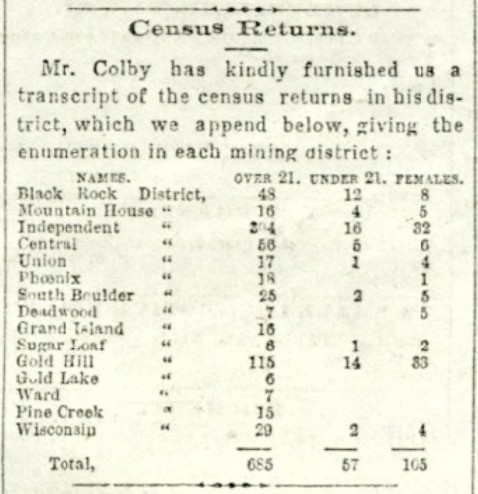
Figure 1. Early enumeration data from several mining districts in Colorado.5
As snippets about the results were published, buzz began to circulate about an undercount. The Rocky Mountain News reported that individuals and families were skipped.6 Denver City Council approved a census committee to ensure a more accurate count of Denver residents.7 The recount happened quickly; four days after the City Council meeting, the census marshal for Denver reported adding 120 more people.8
The original records of the 1861 territorial census are missing. At this time there is no information on when or how the records became lost, and this genealogy librarian has hope they might someday be found tucked away safe and complete in an archival collection. While the records are unavailable, statistical information survived thanks to The Rocky Mountain News. Areas of Colorado were broken into districts, and the districts were defined by settlements, landmarks, and directions. The categories The Rocky Mountain News reported on are white males over the age of 21, white males under the age of 21, total number of females, total number of Black people, and the total number of inhabitants for the district (figure 2).9 Due to the record loss, it is unknown if the census marshals asked more specific questions.
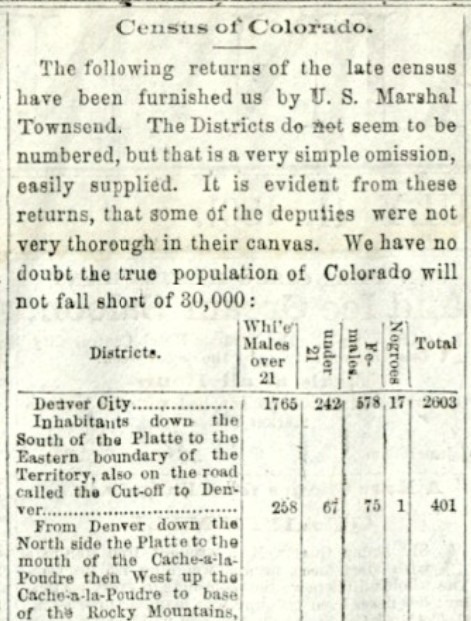
Figure 2. Census results in the Rocky Mountain News.
Denver reported a total population of 2,603; the district that included Fall River, York, Upper Fall River, White Water, Lincoln, Snowy Range, Morris, Eldorado, and Mill Creek counted only 179 people. The totals for the Colorado Territory came to a population of 25,329 people, which included 18,136 white males over the age of 21; 2,622 white males under the age of 21; 4,481 females, and 89 Black people.10 As of this writing the Rocky Mountain News articles are the most credible records remaining of this lost census.11 Like the residents of Denver at the time, researchers should be cautious with the data. With the information we have, it is unknown how accurate the count was, what the enumeration process entailed, or if there was inclination for fraud. We do know the purpose of the census was to determine representation, that Coloradans were motivated, and that the Rocky Mountain News believed, “it is safe, we think, to put down the actual resident population of Colorado at 30,000.”12
The completion of the census allowed for the Colorado Territory to hold its first general election on 19 August 1861.13 The 1861 election created general election poll books; and while it is not the intended purpose, these poll books can be considered a census substitute, albeit one only chronicling the people who voted that day. It does not include people who were not eligible to vote or who were eligible but did not vote. The Colorado Organic Act ruled who was qualified to vote in the territory’s first election:
That every free white male citizen of the United States above the age of twenty-one years, who shall have been a resident of said Territory at the time of the passage of this act, including those recognized as citizens by the treaty with the Republic of Mexico, concluded February two, [1848], and the treaty negotiated with the same country on the thirtieth day of December, [1853], shall be entitled to vote at the first election, and shall be eligible to any office within the said Territory ; but the qualifications of voters and of holding office at all subsequent elections shall be such as shall be prescribed by the legislative assembly.14
On Tuesday, 10 September 1861, the second day of the first session, Governor Gilpin addressed the new Legislative Assembly. He gave the Legislative Assembly a copy of the Territorial Census and the results of the general election. Regarding the census, Gilpin’s words to the Assembly were:
The census reveals many valuable and very novel facts. The comparative proportions of our people devoted to mining within the mountains; to agriculture upon the great rivers, and those residing within the commercial towns, are clearly demonstrated. The aggregate population is 30,000. The predominance in numbers of male citizens over females and children, is a fact so remarkable as to have no recorded precedent in any new society voluntarily planted and perpetuated in the wilderness.15
The original volumes of the general election poll books can be accessed at the Colorado State Archives. In 1996, members of the Colorado Genealogical Society extracted the names of voters in the 1861 election. Their work can be found as a research tool on our website titled, “Colorado 1861 Territorial Election.”
In addition to the resources referenced in this writing, the Denver Public Library has the following resources:
- “Election Records 1861,” microfilmed copies of the original poll books held at the Colorado State Archives (G324.9788 C719eLe MICROFILM)
- Colorado Voters in the 1861 Territorial Election for a Delegate to the 37th Congress : a Supplement prepared by Glenn R. Scott (Closed Stacks: C978.8 C7189 1996 SUPP.)
- “Colorado Election Poll-Book Abstracts, 1861” (Closed Stacks: M150)
1U.S. Congress, U.S. Statutes at Large, volume 12 (Boston: Little, Brown and Company, 1863), page 172, “An Act to Provide a Temporary Government for the Territory of Colorado;” Library of Congress (https://www.loc.gov/resource/llsalvol.llsal_012/?sp=204).
2U.S. Congress, U.S. Statutes at Large, volume 12 (Boston: Little, Brown and Company, 1863), page 173, “An Act to Provide a Temporary Government for the Territory of Colorado;” Library of Congress (https://www.loc.gov/resource/llsalvol.llsal_012/?sp=205).
3“Arrival of Our Governor,” Rocky Mountain News, 27 May 1861, page 2, column 1; Colorado Historic Newspapers Collection (https://www.coloradohistoricnewspapers.org/?a=d&d=RMD18610527-01.2.3 : accessed 2026).
4“Early Organization,” Rocky Mountain News, 29 May 1861, page 2, column 1; Colorado Historic Newspapers Collection (https://www.coloradohistoricnewspapers.org/?a=d&d=RMD18610529-01.2.5 : accessed 2026).
5“Census Returns,” Rocky Mountain News, 26 June 1861, page 2, column 2; Colorado Historic Newspapers Collection (https://www.coloradohistoricnewspapers.org/?a=d&d=RMD18610626-01.2.7 : accessed 2026).
6“The Census,” Rocky Mountain News, 27 June 1861, page 2, column 1; Colorado Historic Newspapers Collection (https://www.coloradohistoricnewspapers.org/?a=d&d=RMD18610627-01.2.3 : accessed 2026).
7“Council Proceedings,” Rocky Mountain News, 27 June 1861, page 2, column 2; Colorado Historic Newspapers Collection (https://www.coloradohistoricnewspapers.org/?a=d&d=RMD18610627-01.2.7 : accessed 2026).
8“Census,” Rocky Mountain News, 29 June 1861, page 3, column 1; Colorado Historic Newspapers Collection (https://www.coloradohistoricnewspapers.org/?a=d&d=RMD18610629-01.2.9 : accessed 2026).
9“Census of Colorado,” Rocky Mountain News, 11 July 1861, page 2, column 2; Colorado Historic Newspapers Collection (https://www.coloradohistoricnewspapers.org/?a=d&d=RMD18610711-01.2.6 : accessed 2026).
10 ibid.
11Early Records of Gilpin County, Colorado, 1859-1861 edited by Thomas Maitland Marshall, Ph. D. indicates on page xii that the 1 August 1861 issue of The Colorado City Journal also published data from the 1861 census. In Early Records of Gilpin County, Marshall only provides the population total for the territory. Based on that information, it’s likely the article in The Colorado City Journal is a reprint of what was published in the Rocky Mountain News, however this issue is scarce and not held by DPL. Marshall’s work (published in 1920) says the copy of the paper is held at the University of Colorado.
12“Our Population,” Rocky Mountain News, 6 July 1861, page 2, column 2; Colorado Historic Newspapers Collection (https://www.coloradohistoricnewspapers.org/?a=d&d=RMD18610706-01.2.5 : accessed 2026).
13“A Proclamation By His Excellency, William Gilpin, Governor of Colorado Territory,” Rocky Mountain News, 19 August 1861, page 3, column 3; Colorado Historic Newspapers Collection (https://www.coloradohistoricnewspapers.org/?a=d&d=RMD18610819-01.2.11.3 : accessed 2026).
14U.S. Statutes at Large, 12 (1863), 173, “An Act to Provide a Temporary Government for the Territory of Colorado.”
15Council Journal of the Legislative Assembly of the Territory of Colorado: First Session (Denver: Thos. Gibson, 1862); Denver Public Library, Special Collections and Archives, C328.788 C712co 1861.
Add new comment