
This tutorial will teach you how to format a parcel number and find it in the online research tool DENVER ASSESSOR RECORDS - LATE 1950s TO THE EARLY 1980s, which contains digitized cards of master property records that are organized by parcel number.
While searching by property address is possible, search results may be unsatisfactory. These parcel cards are part of the collection City and County of Denver, Department of Finance, Assessment Division Records (WH2010).
In-person research is also available for these parcel cards. An index for determining which box to request at the Special Collections and Archives reference desk at the Central Library is available in the collection's guide.
Retrieve the 13-digit schedule number of the property using the Denver Assessor’s Property Taxation and Assessment System database.
Below is an example of a schedule number:
Schedule number: 0232316005000
Let's use the example a property with a schedule number of 0232316005000.
- The first five digits of schedule number is the property's assessment map number. Use the Assessment Map Index to determine this number.
- Assessment map number is indicated in bold: 0232316005000
- Assessment map number is indicated in bold: 0232316005000
- The next two digits (digits 6 and 7) represent the Assessor-assigned block number. (Note: this block number is different than the legal description block number; it can be found through the Denver Assessor’s Map.)
- Assessor-assigned block number is indicated in bold: 0232316005000
- Assessor-assigned block number is indicated in bold: 0232316005000
- The following three digits (digits 8 through 10) represent the property's unique property ID (which also can be found on the Denver Assessor’s Map).
- Unique property ID is indicated in bold: 0232316005000
- Unique property ID is indicated in bold: 0232316005000
- The final three digits of the schedule number are always three zeros.
- Final digits in bold: 0232316005000
To locate a parcel card in the digitized parcel cards, format your 13-digit schedule number (example: 0232316005000) in the following way:
First, add a hyphen and then a 0 after the first five digits of the schedule number.
- 02323-016005000
Next, remove the remaining six digits. Your number will resemble the format below. This will be the number you will use for your online search in STEP 3.
- 02323-016
Search the DENVER ASSESSOR RECORDS - LATE 1950s TO THE EARLY 1980s research tool with your formatted schedule number (our example number is: 02323-016).
Your search may yield several results that match your formatted schedule number. Examine the pages in each result until you come across the card with the matching street address and/or legal description.
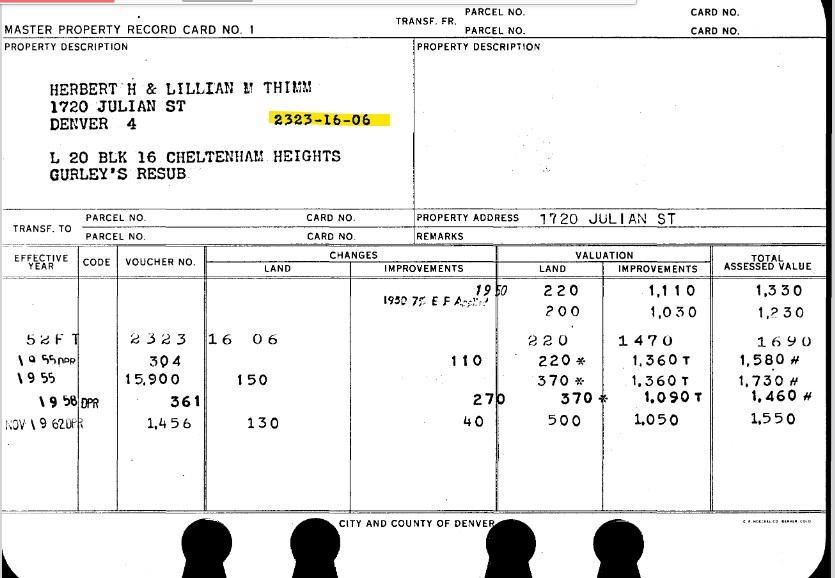
In-person research is also available for parcel cards. An index for determining which box to request to view in Special Collections and Archives at the Central Library is available in the collection's guide. The collection is City and County of Denver, Department of Finance, Assessment Division Records (WH2010).
You will need to format your Schedule Number, however, in a different format. We will show an example using Schedule Number 0232316005000.
- First, drop the first digit (which will be a zero) and add a hyphen after the four digits.
- 2323-16005000
- After the hyphen, count two digits. Place a hyphen after these digits.
- 2323-16-005000
- Finally, remove the last three zeros of the Schedule Number, so that you are left with a nine-digit number:
- 2323-16-005
You can now locate your parcel number range in the in the collection's guide. This will assist you in determining which box to request to view in Special Collections and Archives at the Central Library
Not finding what you need? Contact the Special Collections and Archives Department.
Denver Assessor Records - late 1950s to the early 1980s
The Master Property Record cards show the chain of ownership of Denver property by Parcel Number, from the late 1950s to the early 1980s. The Parcel Number can be found on the Denver Assessor’s Office Real Property Search website. Try searching them by address or parcel number. If you have trouble finding the card online, please see our tutorial or ask for assistance at the Special Collections and Archives Reference Desk.